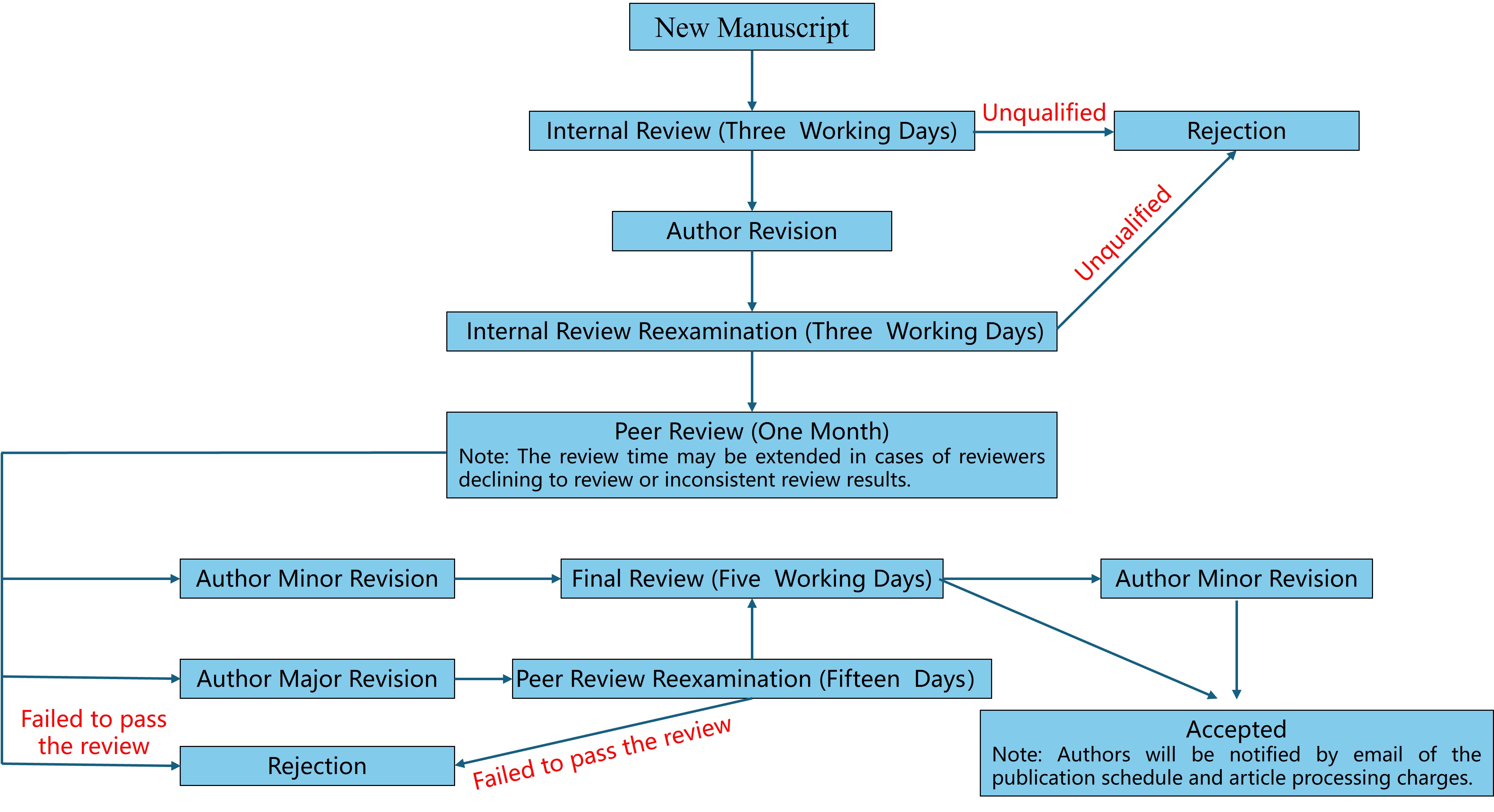
Please read the "Instructions to Authors" carefully before submission. Once submitting papers, authors will be automatically deemed to have read the "Instructions to Authors" and have understood and accepted the contents and requirements contained herein.
1. Aims and Scope
Journal of Netshape Forming Engineering primarily focuses on the scientific research, new technologies and new processes in the field of advanced materials, such as light alloy, iron and steel, composites, superalloy, ceramics, high-entropy alloy and amorphous alloy, macromolecular compound, refractory metal, plastic forming, casting, advanced joining technology, additive manufacturing, et al.
Regular columns: Iron and Steel Forming, Light Alloy Forming, Composites Forming, Copper Alloy Forming, Superalloy Forming, Ceramics Forming,High-Entropy Alloy and Amorphous Alloy Forming, Refractory Metal Forming, Polymer Manufacturing, Advanced Manufacturing Technology and Equipment, advanced joining technology, additive manufacturing.
2. Submission Requirements
Papers shall be original, novel, scientific, important, interesting and expressive, with accurate expression, concise text, prominent focus, true data and credible conclusion.
2.1 Title
Title shall be concise and conspicuous and can accurately reflect the main content of the full text, usually no more than 20 words. Symbols, shorter forms, abbreviations and trade names shall be avoided as far as possible. All papers must be accompanied by English titles. Chinese and English titles shall be consistent.
2.2 Author and institution
Author's name shall be listed under the title. The institution ranking the top shall be the owner of intellectual property reported and studied by the paper. If the author belongs to more than one institution, full names of institutions shall be indicated respectively. The names, birth years, educational background, professional titles, positions and research fields of the first author and corresponding author shall be listed in detail in both Chinese and English.
Special instructions: Please list the author and the intellectual property owner in the submission system. Please do not mention the author's name and institution in the uploaded word document, so as to facilitate blind review.
2.3 Abstract and key words
1) Abstract: Chinese and English abstracts are both required. Chinese abstract shall be no less than 400 words and English abstract shall be written according to Chinese abstract. For research paper, the abstract shall be written in four parts: objective, method, result and conclusion. The research content shall be discussed in detail as far as possible, and the main data shall be listed. The purpose of writing shall be the objective of this research, not the content. For English abstract, past tense shall be used to describe the research and present tense shall be used to make conclusions.
2) Key words: 5-8 key words shall be indexed below the Chinese and English abstracts.
2.4 Text
Text shall have an appropriate number of words. For research paper, the words shall be no less than 5,000 (except references). For review paper, the text words (except references) shall be no less than 7,000.
Research paper shall include introduction, experiment, results, discussion and conclusion. Requirement: Point is clear (usually the opinion used to illustrate the topic); arguments are conclusive (referring to the accuracy of experiments, test data, figures and tables, etc.); demonstration is sufficient (meaning that discussion, result analysis and mechanism discussion are detailed but not cumbersome); conclusion is complete.
1) Introduction
It is necessary to elaborate the theoretical basis and background of this research (i.e. the reason for this research), summarize the research status at home and abroad, put forward the expected results of this research, list the directly related references, and point out the advancement and innovation of this research. In the narrative part, meaning shall be clear and expressions shall be concise, not including data and conclusions (repeating with the abstract).
2) Experiment
It shall be distinguished from the experiment report. In principle, instruments and drugs are not required to be listed in a separate chapter, but should be explained clearly in the experiment process. Basic research process shall be clearly described. Reliability of the research shall be guaranteed, so that readers can verify the experiment according to the content.
3) Results and conclusion
Observation results shall be described in logical order in the text, figures and tables. Arrangement principle of seeing text before figures and tables shall be followed. Figures and tables shall not be set across chapters. Figures and tables shall not repeat the same data and text shall not repeat the same figures and tables. Pictures shall be clear with a resolution no less than 300 dpi. Figures and tables are numbered consecutively in the order of appearing in the text, and the titles shall be concise (without detailing the experiment conditions) and written in both Chinese and English. Coordinate diagram shall have horizontal and vertical coordinates (physical meaning of the marked value) and corresponding units (international system of units); Photographs shall be marked with scale. If figures and tables are quoted from other publications, the source shall be indicated, and the written materials agreed by the copyright owner shall be attached.
Terms involved in the paper shall be subject to the relevant terminology approved and published by the China National Committee for Terminology in Science and Technology. Chinese and foreign terms shall be written in full, and abbreviations shall be marked with brackets when firstly appearing
Measurement units involved in the paper shall be statutory unit. The percentage of concentration involved shall be clearly written, such as mass fraction, molar fraction, volume fraction, etc.
4) Conclusion
Emphasis shall be placed on innovative and important findings, shortcomings of the research and opinions from the experiment results. Data or other materials mentioned in introduction or results shall not be repeated. Possible impacts of these findings and significance of further research can be inferred in combination with the research results.
2.5 Fund project
If the research in the paper is funded, please indicate the name and number of the fund project in both Chinese and English.
2.6 References
The journals or books published in recent years that authors have read in person shall be selected. The sequential coding system can be adopted. The references shall be numbered in order of citation and the serial number shall be marked in the square brackets in the upper right corner. For review paper, the references shall be no less than 50. For research paper, the references shall be no less than 25. All references shall be listed in citation order at the end. The Editorial Department shall have the right to delete unreasonable references or add missing references. If the original is in Chinese, it is necessary to write English translation at the same time (the English in the original text shall prevail). Please pay attention to the accuracy of references. Writing form is as follows:
(1) Journal:[No.]Author.Title of reference[J].Name of journal, Year, Volume (Issue):Start page-end page.
(2) Monograph:[No.]Author.Title of reference[M].Place of publication, Press,Publication year:Start page-end page.
(3) Academic paper: [No.]Author.Title of Reference[D]. Place of publication, Press,Publication year:Start page-end page.
(4) Collected papers: [No.]Author.Title of reference[C]//Name of collection. Place of publication: Press, Publication year:Start page-end page.
(5) Patent: [No.]Patent owner. Title of patent: Country of patent, Patent No.[P]. Announcement or publicity date(day/month/year).
(6) Standard: [No.]Standard No., Standard Name[S].
(7) Electronic reference: [No.]Author. Title of electronic reference[electronic reference and carrier type identification].Source or available address of electronic reference, publication or update date/citation date (optional).
Authors no more than 3 shall be listed, with “,” separating names; For more than 4 authors, the first three shall be listed, and then "et al." shall be added after the third name. The author's name in English reference shall be written as follows: complete surname first and first name last. The titles of journals in the references shall be standard full name.
3. Processing of Submissions
Papers published in the Journal shall be processed in the following link: submission → internal review → peer review → final review, all of which are conducted online and offline submission is not accepted.
Authors can log in to www.nsforming.com, the website of the Journal, and submit papers after registering accountants. After submission, authors can log in to the website at any time to check the paper processing status. Please read the "Instructions to Authors" carefully before submission. Once submitting papers, authors will be automatically deemed to have read the "Instructions to Authors" and have understood and accepted the contents and requirements contained herein. When submitting papers, please fill in the real information of papers and authors carefully, otherwise the processing progress of papers may be affected.
A double-blind peer review process is adopted for this journal. All submissions, including featured articles, special issues, editor-in-chief invited contributions, editor-invited papers, and free submissions will be reviewed by two or more experts.
4. Confidentiality requirements
(1) Authors must ensure that the article does not contain any state secrets, corporate trade secrets, technical secrets, or politically sensitive information. The fund program supporting the article must not be a classified research project (or topic). The names of the authors’ affiliations must be publicly identifiable; otherwise the authors should be solely responsible.
(2) When submitting the final version of an article, please include a non-classified certificate issued by the confidentiality department of the first copyright-affiliated institution (please download the template from the left Download Zone of this journal’s official website, complete the required information, and then stamp it with the official seal of the first institution. Note: The filled-in content, signature, and date must be either entirely handwritten or entirely printed. A secondary department seal may be used. Please upload a scanned PDF version with the seal and signature clearly visible and compliant with regulations.
5. Transfer of copyright
Before submission, authors shall carefully understand the contents of "Copyright Transfer Agreement and Submission Commitment" specified by the Journal (download the template of "Copyright Transfer Agreement and Submission Commitment" below the web page). Once submitting papers, authors will be regarded as familiar with the contents "Copyright Transfer Agreement and Submission Commitment" and deemed to have agreed to transfer the right of revision, reproduction, distribution, information network transmission, translation and assembly in the paper copyright to the Journal worldwide.
After receiving the collection notice of papers, authors shall submit the "Copyright Transfer Agreement and Submission Commitment" signed by all paper authors as soon as possible. After receiving the Agreement, the Journal will arrange the publication of papers.
6. Cost of Publication
After the papers pass the internal review, a review fee will be charged according to the standard of RMB 200/paper. For the papers that have been confirmed to be published, a publishing fee will be charged according to the standard of RMB 2,500/paper.
For articles that have been published, appropriate remuneration will be paid in a suitable manner.
7. Appeal
If an author disagrees with the review decision, he/she may submit an appeal to the Editorial Department with detailed reasons for disputing the review decision.
After receiving the appeal, the Editorial Department will organize specially-assigned persons for verification. Once the appeal is confirmed to be reasonable, review arbitration will be arranged as soon as possible.
8. Publication Date
The Journal is issued on a monthly basis. On the 10th day of each month, the electronic version of current papers will be finalized and submitted to various databases for processing and printing.
The time for authors to retrieve papers in each database is based on the data processing time, and the normal data processing cycle of each database is 4-8 weeks.
9. Accessibility
Authors can receive the complimentary paper journal at the beginning of the month following the publication month. Each published paper will be offered with two journals. In addition, authors can also obtain paper journals by subscription. Please refer to the "Subscription Service" of the website for subscription methods.
All authors can get the full text included in the Journal free of charge on the website.
For other special circumstances, please contact the Editorial Department. For the contact information of the Editorial Department, please see "Contact Us" on the website.
10. Archive
All paper publications and electronic data in recent 10 years have been archived.